Every December, Nigeria transforms into a living gallery of colour, rhythm, memory, and movement. Streets become stages, history dances with the present, and communities open their arms to the world. From the coastal energy of Lagos to the ancient heartbeat of Onitsha, the creative fire of Abuja, and the grand spectacle of Cross River, December’s cultural festivals have evolved beyond celebration. They are now powerful engines of tourism, identity, and economic growth.
This is Destination December, and Nigeria is telling its story in the loudest, proudest, and most beautiful ways.
Golibe Street Carnival: The Soul of Onitsha on Display
Proudly Onicha Ado N’Idu — this is home.
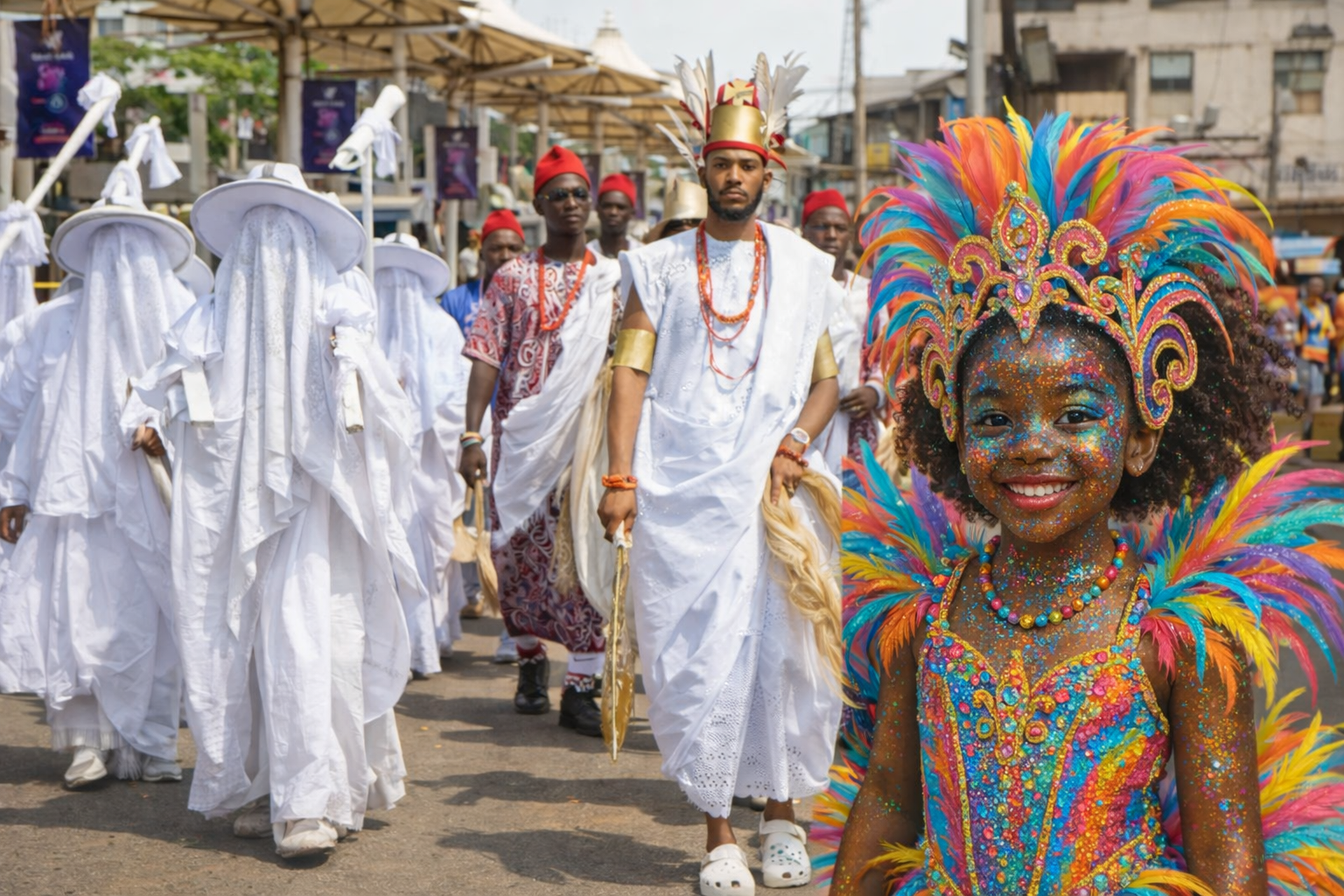
Few festivals capture the raw spirit of a people like the Golibe Street Carnival. Deeply rooted in tradition and alive with contemporary energy, Golibe is more than a carnival, it is a declaration of identity. Every drumbeat echoes ancestral pride, every dance step carries history, and every costume tells stories of resilience, unity, and joy.
Here, culture is not staged for spectacle alone; it is lived. The streets of Onitsha come alive with colour, movement, and soul, reminding both indigenes and visitors that heritage is strongest when shared. Golibe stands as powerful proof that grassroots cultural platforms remain vital preserving identity while inspiring younger generations to embrace and protect their roots.
Eyo Festival: Lagos’ Living Heritage
Few cultural expressions are as iconic as the Eyo Festival, also known as the Adamu Orisha Play. Clad in flowing white, the Eyo masquerades glide through Lagos Island, symbolising ancestral guidance, continuity, and unity.
Rooted in centuries of tradition, the festival honours the passing of notable Lagos indigenes, marks historic milestones, and celebrates major transitions in the life of the state. Beyond its visual splendour, Eyo is a reminder that Lagos is not merely a global megacity it is a custodian of living heritage.
Each Eyo group represents lineage, family ties, and collective memory preserved across generations. From the historic streets of Lagos Island to global audiences, the Eyo Festival continues to tell a story of a people rich in culture, grounded in tradition, and united in celebration.

Naija Flavour Abuja: Where Culture Meets Lifestyle
In the heart of the nation’s capital, Naija Flavour Abuja delivers a vibrant fusion of food, music, fashion, and lifestyle. Designed to showcase Nigerian creativity at its finest, the event creates a dynamic space for connection, celebration, and commerce.
More than entertainment, Naija Flavour highlights how cultural experiences during Destination December drive tourism, support small and medium-scale businesses, and unlock opportunities across hospitality, food, fashion, and the wider creative economy. It is culture with impact where enjoyment meets enterprise and creativity translates into growth.

Carnival Calabar: Traces of Time
Often described as Africa’s biggest street party, Carnival Calabar continues to set the benchmark. Under its 2025 theme, Traces of Time, the carnival unfolds as a living archive a museum in motion, and a constantly evolving masterpiece.
With global attention on Cross River State, the mission is clear: to honour heritage, celebrate heroes, and capture the spirit of the present. Through elaborate costumes, immersive storytelling, music, and dance, Carnival Calabar transcends entertainment, positioning itself as a cultural export that draws visitors from around the world and strengthens Nigeria’s place on the global tourism map.

Beyond the Headlines: A Nation in Celebration
Beyond these flagship festivals, December is marked by numerous cultural expressions across Nigeria. From community masquerade festivals and traditional wrestling contests to riverine boat regattas, art exhibitions, music and dance showcases, fashion fairs, and craft markets, the season reveals a rich mosaic of Nigeria’s diversity and creative depth.
Detty December: Culture Beyond the Concerts
Detty December is no longer defined solely by sold-out concerts and headline performances. Beyond the bright lights and booming speakers, a deeper cultural movement unfolds rooted in community, heritage, and creative expression. Street carnivals spill into neighbourhoods, block parties turn ordinary roads into celebration grounds, and cultural showcases blend history, fashion, food, music, and dance into shared experiences. For weeks, cities breathe culture, powered by Afrobeat rhythms and collective joy.
Nowhere is this more evident than in Lagos, where Detty December has grown into Nigeria’s biggest music and lifestyle season. From early December through the New Year, Afrobeats shows, festivals, and parties dominate the calendar, drawing locals, diaspora returnees, and international visitors. It is a dynamic mix of live performances by Nigeria’s biggest stars, electric crowd energy, and immersive cultural moments that celebrate both the roots and the global rise of Afrobeats.
Flagship events anchor the season. Flytime Fest, held annually at the Eko Convention Centre, remains a Detty December institution. Spanning several nights, it showcases the depth and evolution of Nigerian music—from Rhythm Unplugged headlined by Rema, to Flavour’s highlife-infused performance, Asake’s Christmas Eve takeover, and Davido’s Christmas Day finale. With roots tracing back to the early 2000s, Flytime Fest remains one of Lagos’ longest-running and most influential music celebrations.
Equally significant is Wizkid’s GOAT Experience at Tafawa Balewa Square, a landmark homecoming concert that draws massive crowds and reinforces Nigeria’s position at the centre of the global Afrobeats movement. These events do more than entertain; they shape cultural memory and set the tone for the season.
Culture as a Destination
Beyond headline concerts, a quieter but equally powerful transformation is underway. Across Nigeria, creatives and cultural practitioners increasingly recognise festivals as tools for development rather than mere entertainment. These platforms provide structure, visibility, and economic opportunity for artists, designers, dancers, curators, vendors, and storytellers whose work might otherwise remain unseen.
Cultural showcases such as Culturati exemplify this shift. They are intentional spaces where tradition meets modern expression where heritage is not archived, but activated. Through such platforms, indigenous narratives are preserved, creative economies are stimulated, and young talents gain access to audiences, partnerships, and income. In the process, festivals create jobs, support small businesses, and keep cultural knowledge alive for future generations.
When culture is celebrated intentionally, it becomes a powerful engine for tourism, investment, and nation branding. December’s festivals attract not only Nigerians at home, but members of the diaspora and international visitors seeking authentic African experiences. Each parade, performance, and pop-up market contributes to a larger narrative, one that positions Nigeria as a vibrant, creative, and culturally confident destination on the global stage.
Ultimately, Destination December is living proof that Nigeria’s culture is not only rich in history and expression, but also economically powerful. It shows what is possible when creativity is valued, heritage is protected, and culture is treated not as spectacle, but as infrastructure for long-term development.
Nigeria is not just a place to visit in December—it is a story to experience.